
To all my friends suddenly homeschooling:
I want to share some tips to hopefully help your time homeschooling be a little easier for you and your kids. I’ve been homeschooling for a few years now (our oldest is in 3rd grade) so I’m not an expert but I’ve got experience. A little background, I first thought about homeschooling because of the way one of my favorite high school teachers structured his math class. Mr. Donahue spent almost the entire class period working with students one-on-one, and because of the way he ran things we could work ahead if a concept came easily or take more time if something was a bit more challenging. He had this low-stress, “isn’t this math thing cool?” kind of vibe that was contagious. Mr. Donahue’s class was the most comfortable and confident I’d ever felt in math and I loved learning from him. I loved not having to spend a ton of time on something I already understood, as well as getting extra instruction when needed rather than having to keep moving on with a gap in my understanding. Now his setup is a big part of how we homeschool. Anyway, we’ve LOVED homeschooling. Here are some thoughts and tips to help you through what will hopefully only be the next few weeks!
1. Do what you feel is best for your family. You do you. Your time schooling at home should resemble the way your family lives. Ideally your homeschooling time will be an extension of your family time and the way you live, play, and interact as a family. If you’re not a rigid, tightly scheduled parent then don’t force yourself to be a rigid, tightly scheduled homeschooler. If you run a tight ship then don’t try to force freeform schooling. Try things out, if they don’t fit then try something else.
2. Be easy on yourself. There’s a ton of information out there, a ton of resources, and lots of opinions which can make an already challenging situation feel overwhelming. Most homeschool parents make the decision to homeschool after a lot of consideration, most of us don’t have it quickly forced upon us by some apocalypse-level pandemic. I had a few years to work out what kind of homeschool experience I wanted to create and get to the kind of schooling we have now. Also, our homeschooling typically involves weekly homeschool playgroups, trips to museums, the zoo, the aquarium, the library, going on hikes, etc. Having to do all of it at home is challenging even for those of us used to homeschooling. If you hit your breaking point and your day of school needs to be watching Planet Earth while snuggled up on the couch then so be it. Take it easy on yourself, you’re doing a hard thing, and you can do hard things.
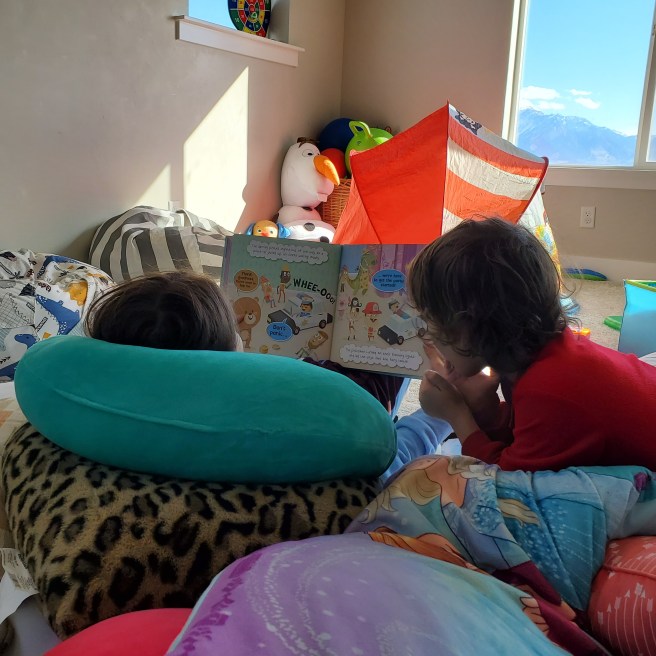
3. Don’t try to replicate the public school model at home. You’re not educating your kids at a 30-1 ratio. You’ll be able to work through the material with your child in less time (we’re usually done with homeschool material before lunch). You don’t need to do crowd control so it’s okay for your kiddo to wander around (or jump, spin, whatever) or snuggle up in a blanket while they work. The school model is for the school classroom, learning at home doesn’t need to look the same. If you try to replicate their classroom experience exactly you’ll likely find yourself stressed out.
4. Combine learning and play. Go over math facts while playing Uno, play word games while jumping with them on a trampoline, teach history in a blanket fort, practice fractions while baking cookies, talk physics while kicking a soccer ball around the yard, use geometry while doing arts and crafts together. Have your child help you create a game (now they’re using problem solving, teamwork, applying a concept, AND strengthening that parent/child bond). Kids should play and learning should be fun.
5. Let them sleep in. If their growing bodies need more rest let them sleep in later than they would on non-pandemic school days.
6. On that note, schooling in jammies is perfectly acceptable and cozy. Some homeschool parents feel their kids do better if they get up and get dressed first, we’re ‘work in jammies’ kind of people.
7. Google is your friend. If your child is having a hard time understanding a concept there is probably a game to help them learn and practice it. Do a search for “[concept/subject] [grade level] kids games” (for example “fractions 3rd grade kids games”) and there should be some fun instruction and practice for them. Also, if you’re a little rusty on a subject you can Google the information to get yourself up to speed with the most up to date information. Or, if your child is curious and really engaged in a subject you can look up more content for them (YouTube videos, virtual tours, etc.).
8. Give them context and apply what they’ve learned. “Remember when you learned about that yesterday? Here it is in action!” While you’re schooling at home you know everything they’re learning in school AND can help them learn using details from their own life experience. Learning about plate tectonics? Talk about the formation of the mountains they see out their window. Learning about the water cycle? Point out clouds, storm drains, etc. on a walk through your own neighborhood. As their parent you get to use details from their own experience and to apply what they’ve learned to their daily life.
I hope this helps a little. Good luck!
(Any of my homeschool friends feel free to add to this list!)

 Jess Building Joy